Composer Profile
Giacomo Puccini (1858–1924) by Kristin Rasmussen
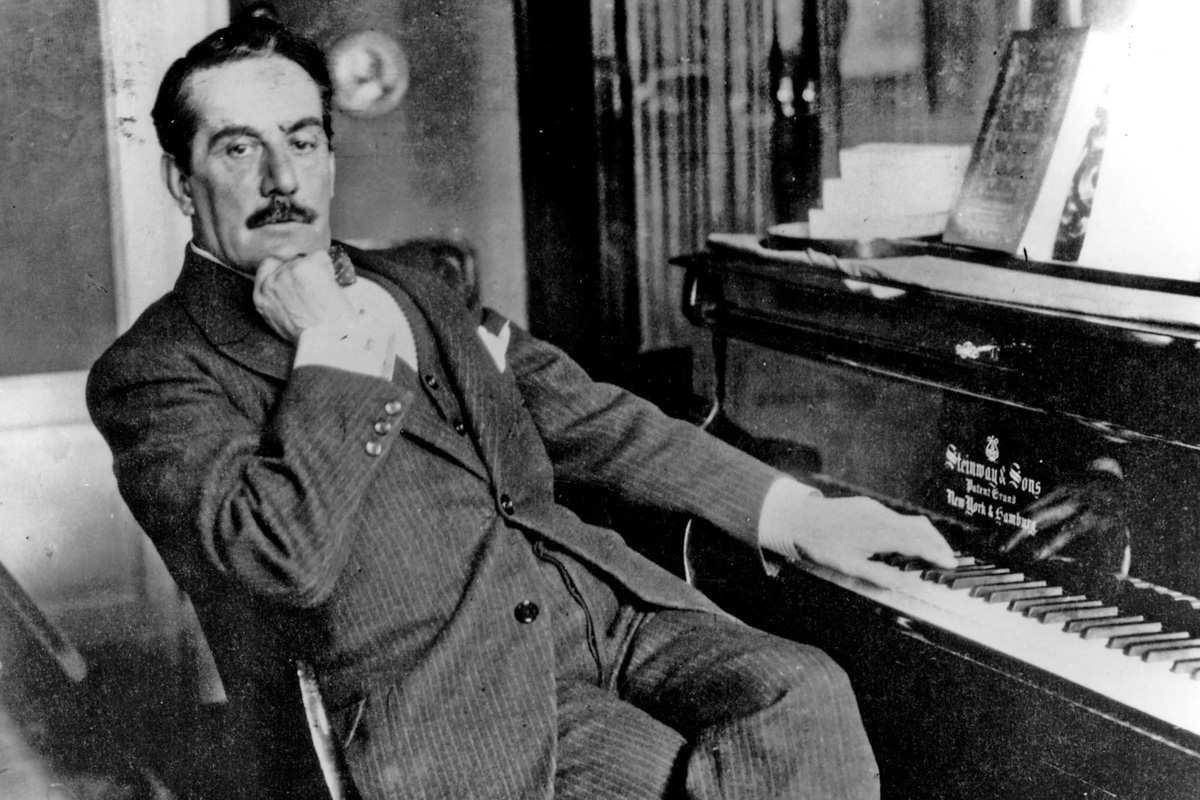
Giacomo Puccini (1858–1924) was descended from a dynasty of Italian court composers and organists in Lucca, Italy. Both in his lifetime and today, he is regarded as the greatest composer of Italian opera since Verdi. As the final member of a family that had supplied the musical directors of Lucca's Cathedral of San Martino for two centuries, Giacomo Puccini's life was certain to center around music. His family provided him with his early musical education, but he soon outgrew it and proceeded to the Milan Conservatory to continue his studies.
Le Villi (1884), Puccini's debut opera, was written for a composition contest. Despite losing first-place, a private performance of the piece generated enough interest for a complete production, bringing Puccini into the public eye for the first time. Le Villi introduced Puccini to publisher Giulio Ricordi, a musician himself, and recognized Puccini's potential. Ricordi was among the first to identify Puccini as Verdi's legitimate heir. His subsequent work, Edgar (1889), would establish the norm for Puccini's librettos and plots based on earlier works of literature. He focused on interpretations of French, Italian, and English plays, novels, and poetic works.
Despite Edgar's lack of success compared to Le Villi, Puccini continued writing, now with the assistance of Ricordi and several librettists. Four years after Edgar came Manon Lescaut (1893), which established Puccini’s sense of style. As Italian musicologist and Puccini expert Michele Girardi stated, “With Manon Lescaut, Puccini’s genius caught fire.” In Manon Lescaut he blended the Italian idea of drama in musica, in which the melody serves as the primary support, with Richard Wagner's concept of leitmotifs, which are themes connected to certain concepts, people, or objects. His music's thematic linkages become complex; the orchestra frequently takes center stage and establishes intricate connections between themes and characters. Manon Lescaut also demonstrated Puccini's ongoing preoccupation with and depiction of the heroine's complex psychology.
In Puccini's next work, La bohème (1896), he placed high value on poetic meter and sought to further break free from the constraints of a number opera. The music was manipulated to highlight the gestures of daily life and simultaneously establish the higher-level narratives. Through freeing the work from prior norms and the limitations of conventional narrative structure, Puccini escaped the constraints of time, giving weight to the Bohème’s final tragedy. Puccini’s subsequent works, Tosca (1900), Madama Butterfly (1904), and La fanciulla del West (1910), follow Bohème’s themes of a deeply moving love story, the inner psyche of the female heroine, and the further expansion of Puccini's operatic style. Wagnerian-esque leitmotifs, original and memorable melodies, imaginative tone colors, and motivic elaboration contributed to Puccini's ongoing and daring successes.
Puccini's life was characterized by overindulgence and complex romantic and familial ties, much like the lives of many other composers of his day. The death of his mother cast a long shadow over his early compositional career, and his marriage was tumultuous from the start. His wife, Elvira, was married and a student of his when their entanglement began. Their relationship was afflicted by Puccini's many affairs with singers and aristocrats, and this tension eventually resulted in the suicide of a maid in the Puccini family service after she had been repeatedly accused by Elvira of having an affair with the composer.
In the final years of his life, Puccini, who had been a lifelong chain-smoker, complained of a persistent sore throat. This eventually developed into throat cancer, and he was unable to complete the last scene of his final opera, Turandot (1925), before dying in 1924. After much debate over who would finish it, Franco Alfano, an Italian composer, eventually completed the score.
Puccini’s impact on Italian opera cannot be overstated. Compositionally, Puccini demonstrated how Italian composers can liberate Italian opera from its antiquated and rigid forms and concepts, introducing it to the world of contemporary music. By manipulating inherited Italian traditions and packing the music with bold harmonic progressions steeped in French, Austrian, and German styles, he demonstrated orchestral mastery unlike any other Italian and worked to set the standard for Verismo style, a desire to portray the world with greater realism. Puccini consistently outperformed his contemporaries, making him one of the most successful Italian composers of the 19th and 20th centuries both during and after his lifetime. In the twenty-first century, he is among the most frequently performed opera composers.