
The History of Of Mice and Men
Written by Kristin Rasmussen
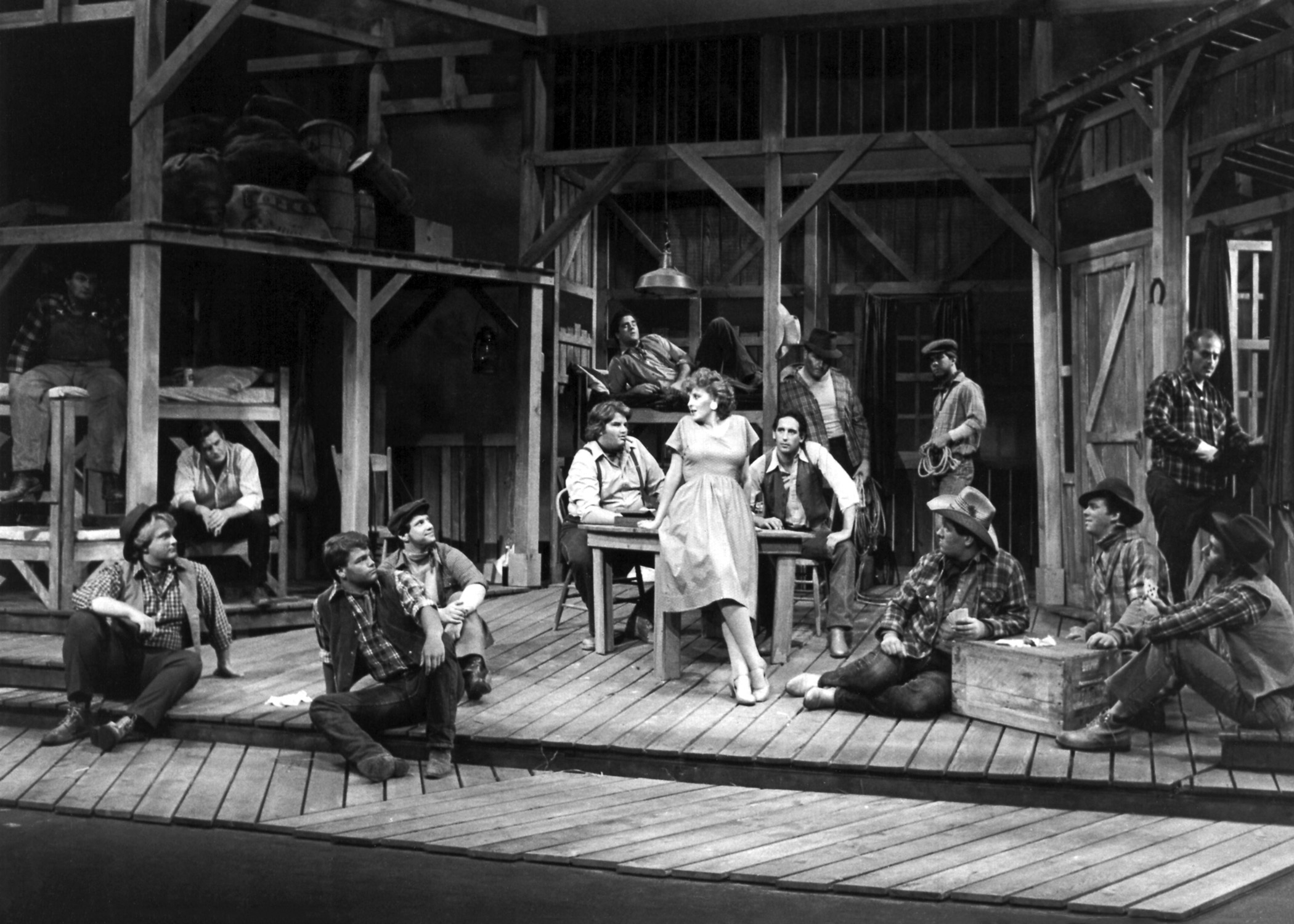
In 1937, American literary genius John Steinbeck published his novella Of Mice and Men. Steinbeck received the most positive reception at that point in his career with this novella, which was quickly lauded by critics and audiences. Within months, Of Mice and Men was performed on stage, and it was adapted and re-adapted numerous times for the theater, television, and radio throughout the 20th century. Carlisle Floyd's operatic adaptation of the novella debuted in January 1970, a little more than a year after Steinbeck's death, and, like the book, the opera has remained in the repertoire and is regarded as an American classic.
John Steinbeck was born on February 27, 1902, in Salinas, California, a few hours south of San Francisco. He was raised in a middle-class family; his father worked consistently and eventually become Monterey County's treasurer. He was close to his three sisters throughout their youth, and his mother instilled in him and his siblings a love of literature and high academic expectations. Steinbeck displayed an aptitude for storytelling in his youth, and throughout high school his teachers used his work as examples for his classmates. He eventually ended up at Stanford. Though he never graduated, Steinbeck spent six years enrolled and took classes throughout their growing English and creative writing departments, going to only what appealed to him. In 1925 he attempted to make a career of writing in New York City, taking odd jobs to support himself, but this was a failed attempt, and he returned to California after two years. Finally, in 1929, he completed his first entire manuscript, "The Cup of Gold," while working as a winter caretaker on a Tahoe estate. The following summer, he met his first wife, Carol, and they relocated to the family vacation cottage in Pacific Grove. He wrote as much as possible here, and his first commercial success came with the comedic novel Tortilla Flat (1935), which is set in Monterey, California, and tells the narrative of paisanos, or countrymen, enjoying life after World War I. Tortilla Flat marked a watershed moment in Steinbeck's career, and he immediately began work on his most successful and enduring works, including In Dubious Battle (1936), Of Mice and Men (1937), and The Grapes of Wrath (1939).
Of Mice and Men is a novella, a type of narrative prose fiction that is both shorter than a regular novel but longer than novelettes or short stories. Of Mice and Men was written by Steinbeck in a novella-play hybrid style. The work, which is divided into three acts with two chapters each, can be a play read as a novella, or as a novella that could be performed as a play. The title is a reference to Scottish poet Robert Burns' poem "To A Mouse," quoting the line "The best laid schemes o' mice an' men / Gang aft agley" ("The best-laid plans of mice and men / Often go awry").
The story follows George Milton, a quick-witted man and Lennie's guardian, and Lennie Small, an intellectually challenged but physically intimidating giant, as they travel about California seeking out work after being displaced by the Great Depression. The premise of the novella is inspired by Steinbeck's own experiences as a teenager working with migrant farmworkers in the 1910s. In 1937, he told the New York Times:
“I was a bindlestiff myself for quite a spell. I worked in the same country that the story is laid in. The characters are composites to a certain extent. Lennie was a real person. He's in an insane asylum in California right now. I worked alongside him for many weeks. He didn't kill a girl. He killed a ranch foreman. Got sore because the boss had fired his pal and stuck a pitchfork right through his stomach. I hate to tell you how many times. I saw him do it. We couldn't stop him until it was too late.”
Of Mice and Men was instantly adapted after its release, making its debut on stage at the Theatre Union of San Francisco in May 1937, a few short months after its publication. It has received numerous on and off Broadway adaptations, the most recent of which premiered in 2014 and starred James Franco. The novella's first film adaptation premiered two years after its release in 1937, and it has subsequently been adapted for television and theater many times. The BBC has also adapted it several times as a radio play.
For Steinbeck, many of his works follow what he described as a “base theme,” the goal of attempting to understand one another and exploring this through close, personal relationships. He explores this in many ways throughout the novella and allows the audience a deeper look into these characters to understand them. Aspirations are constantly highlighted; George, Lennie, Candy, and Crooks all desire a life of independence on their own land, and Curley’s wife wants fame, success, and a friend in her husband. He highlights the loneliness of human existence, particularly during such a bleak time in American history. George and Lennie's connection exists because of their loneliness and challenging economic circumstances. This is exemplified by the ongoing conflict between Curley, the farm's owner's son, and his wife, both of whom exhibit abusive habits, towards each other and the farm workers, and have been unable to form any sort of connection with one another. Throughout the novella the characters work to attempt to understand one another and simultaneously achieve their dreams, but in the end, fate prevents this, and the inherent limitations of their economic and intellectual circumstances prevent them from achieving their dreams.
Like Steinbeck, one of Carlisle Floyd’s strengths lies in his ability to reveal smaller situations and close personal relationships on stage through his works. This, combined with references to American folk idioms, is what made Susannah (1955), Floyd’s first commercially successful opera, so triumphant. Susannah is an adaptation of the biblical story of Susanna and the Elders, and follows the teenage Susannah Polk in the town of New Hope Valley, Tennessee, and her relationships with those in her small town. Floyd wrote the librettos for all of his operas and often based them on distinguished literary sources. Of Mice and Men was no different. He remained largely faithful to the text of the book, transforming it into "down-home" lyrics that portray the characters' miserable existence. The framework of three acts remains unchanged, as does the plot. The most significant change in Floyd's version is the creation of the "Ballad Singer," a tenor role that is a young ranch hand who emphasizes the final lines of melodies in the first and third acts. Floyd's adaptation expanded on the novella's despondent characters. On stage, he could accentuate their loneliness and longing, elevating the novel's drama to the level of epic tragedy. Floyd was able to make the story understandable and relatable to the audience by using the familiar sounds of American folk idioms, hints of country dances, and a constant echo of the emerging American sound of classical music and emphasizing the theme of lost and failed dreams with wide, echoing intervals and biting instrumentation that practically prevents any joy from taking hold.
Floyd worked and reworked Of Mice and Men for several years, saying, "I never revised an opera more." Initially, he presented the first act for Kurt Adler, General Director of the San Francisco Opera. It was rejected, and Floyd scrapped the first act and entirely reworked it with a new libretto and music. Floyd himself stated, "It's the only time I ever did that." The opera was accepted by the Seattle Opera House and premiered on January 22, 1970, a mere 398 days after John Steinbeck's death. On opening night, the audience was enthralled and left stunned at the end of the opera, with shouts of enthusiasm immediately following. The opera was a hit with both crowds and critics. As a February 1970 Times Magazine review said, “Of Mice and Men seems uniquely American. Like Steinbeck’s depression-depressed characters, Floyd’s opera has calluses on its hands and hot blood in its heart. It will probably be around a long time.”
Of Mice and Men is frequently performed throughout opera houses throughout North America. Its New York premiere came in 1983 and was staged in 2011 by Opera Australia at the famed Sydney Opera House. This summer, DMMO takes on Of Mice and Men for the first time since 1985 to celebrate the centennial of the birth of Carlisle Floyd.
Visit www.dmmo.org/tickets or call the box office at 515-209-3257 to learn more!